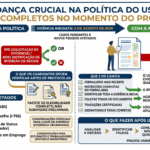


A major change to the U.S. public charge policy will take effect on September 18, 2026, expanding the types of public benefits USCIS may consider when reviewing certain Green Card applications.
U.S. Citizenship and Immigration Services (USCIS) issued updated guidance on August 18, 2026, explaining how immigration officers will determine whether an applicant for adjustment of status is likely at any time to become a “public charge.”
The guidance implements a Department of Homeland Security (DHS) Final Rule published in the Federal Register on July 20, 2026, which rescinds the public charge regulations adopted in 2022 during the Biden administration.
The new policy becomes effective on September 18, 2026.
The change is significant because USCIS officers will once again have broader discretion to consider an applicant’s financial circumstances and receipt of certain means-tested public benefits.
However, one point must be made clear from the beginning:
Receiving a public benefit does not automatically make someone a public charge, and it does not automatically result in the denial of a Green Card.
USCIS must make an individualized determination based on the totality of the applicant’s circumstances.
What Does “Public Charge” Mean?
U.S. immigration law provides that certain noncitizens may be inadmissible if they are determined to be “likely at any time to become a public charge.”
The legal basis for this ground of inadmissibility is Section 212(a)(4) of the Immigration and Nationality Act (INA).
The INA does not provide a comprehensive definition of “public charge.” Instead, Congress requires immigration officers to consider several factors when determining whether an applicant is likely to become a public charge in the future.
The new 2026 policy gives USCIS officers broader discretion to make that determination on a case-by-case basis.
What Changes on September 18, 2026?
This is one of the most important parts of the new policy.
Under the 2022 regulations, the types of public benefits that could be considered in a public charge determination were significantly limited.
Beginning September 18, 2026, USCIS may consider an applicant’s receipt of a broader range of means-tested public benefits — generally, government benefits for which eligibility depends on income, financial resources, or similar economic criteria.
According to the USCIS guidance, this may include benefits such as:
- cash assistance for income maintenance;
- housing assistance;
- food assistance, including food stamps;
- certain financial aid for college; and
- other similar means-tested public benefits.
This represents an important expansion of the evidence that may be considered in a public charge determination.
Receiving Benefits Does NOT Automatically Mean a Green Card Denial
The new policy does not create a rule stating that anyone who receives Medicaid, SNAP, housing assistance, or another public benefit will automatically be denied permanent residence.
Instead, receipt of qualifying benefits may become one factor among many considered by USCIS.
Officers must review the applicant's circumstances as a whole before determining whether the person is likely at any time to become a public charge.
This distinction is critical.
Two applicants who received the same type of government assistance could potentially receive different public charge determinations depending on their overall circumstances.
What Factors Will USCIS Consider?
Federal immigration law specifically requires officers to consider at least five statutory factors.
1. Age
USCIS may consider the applicant's age and how it relates to the person's present or future ability to support themselves.
2. Health
The applicant's health may be considered as part of the overall assessment of future self-sufficiency.
3. Family Status
USCIS may consider household and family circumstances, including factors that affect the applicant's financial situation.
4. Assets, Resources, and Financial Status
Income, financial resources, assets, liabilities, and other indicators of financial stability may become important parts of the analysis.
5. Education and Skills
Education, professional qualifications, employment skills, and other factors affecting the applicant's ability to work and earn income may also be considered.
In addition to these statutory factors, USCIS may consider other relevant evidence when evaluating the totality of the applicant's circumstances.
That may now include a broader review of means-tested public benefits received by the applicant.
What About Form I-864, Affidavit of Support?
For many family-based immigration cases, Form I-864, Affidavit of Support Under Section 213A of the INA, remains extremely important.
Through the I-864, a qualifying sponsor agrees to financially support the intending immigrant and demonstrates sufficient financial resources under federal requirements.
Under the new guidance, USCIS may consider the Affidavit of Support when evaluating whether an applicant is likely to become a public charge.
However, the existence of a qualifying sponsor does not necessarily mean that USCIS must ignore every other factor.
The agency may evaluate the I-864 together with the applicant's age, health, financial situation, education, skills, family circumstances, and other relevant evidence.
Does the Public Charge Rule Apply to Every Immigrant?
No.
This is another extremely important point.
Congress has exempted several immigration categories from the public charge ground of inadmissibility.
Among the major categories generally not subject to the public charge ground are:
- refugees and asylees;
- certain Afghan and Iraqi special immigrants;
- Special Immigrant Juveniles;
- T nonimmigrants who are victims of human trafficking;
- U nonimmigrants who are victims of qualifying criminal activity;
- certain VAWA self-petitioners and qualifying abused immigrants;
- certain applicants adjusting status under the Cuban Adjustment Act;
- certain applicants for Temporary Protected Status;
- certain applicants for registry;
- certain military-related surviving family members; and
- several other categories specifically exempted by federal law.
By contrast, many traditional family-based and employment-based immigrant categories remain subject to the public charge ground.
These include many cases involving:
- spouses, children, and parents of U.S. citizens;
- family preference immigrants;
- spouses and children of lawful permanent residents;
- fiancé(e)s of U.S. citizens;
- EB-1 priority workers;
- EB-2 professionals with advanced degrees and individuals of exceptional ability;
- EB-3 skilled workers, professionals, and other workers;
- EB-5 investors;
- Diversity Visa immigrants; and
- several other immigrant classifications.
For this reason, applicants should first determine whether the public charge ground even applies to their particular immigration category before assuming the new rule affects them.
What If Someone Received Benefits Before September 18?
The new policy contains an important transition rule.
For means-tested public benefits received before September 18, 2026, USCIS will continue applying the narrower treatment applicable under the previous policy.
According to the August 18 USCIS guidance, for benefits received before that date, USCIS will consider only the applicant's receipt of:
- public cash assistance for income maintenance; and
- long-term institutionalization at government expense.
For means-tested public benefits received on or after September 18, 2026, USCIS may consider the broader universe of qualifying benefits under the new policy.
In other words, the government is not simply applying the expanded benefit analysis retroactively to benefits received before the effective date.
The September 18, 2026 cutoff is therefore extremely important.
Which Green Card Applications Will Be Subject to the New Policy?
For adjustment of status cases filed inside the United States, the new guidance applies to Forms I-485 that are subject to the public charge ground and are postmarked or electronically submitted on or after September 18, 2026.
Therefore:
I-485 filed before September 18, 2026:
The application does not automatically become subject to the new guidance simply because USCIS continues processing it after September 18.
I-485 postmarked or electronically submitted on or after September 18, 2026:
The new guidance applies if the applicant's immigration category is subject to the public charge ground of inadmissibility.
The filing date can therefore make an important difference.
USCIS May Allow a Public Charge Bond
The new policy also restores an important mechanism known as a Public Charge Bond.
If USCIS determines that an applicant is inadmissible only because the person is likely at any time to become a public charge, the agency may, in appropriate circumstances, invite the applicant to post a financial bond.
The bond acts as a financial guarantee that the immigrant will not become a public charge.
USCIS may allow either:
- a cash bond; or
- a surety bond issued through a company certified by the U.S. Department of the Treasury.
The process uses Form I-945, Public Charge Bond.
However, applicants should not file Form I-945 on their own initiative.
USCIS states that the form may only be submitted when the agency specifically invites the applicant to post a public charge bond through a Notice of Intent to Deny (NOID).
USCIS will not accept a public charge bond from someone who has not received such an invitation.
When determining the amount of the bond, USCIS may consider how much government assistance the applicant could potentially be eligible to receive during the following five years.
Is This Simply a Return to the 2019 Public Charge Rule?
Not exactly.
The 2026 policy has important similarities to the approach taken during the first Trump administration, particularly because USCIS may once again consider a broader range of benefits and circumstances.
However, DHS has specifically stated that the 2026 Final Rule is not simply reinstating the 2019 Final Rule.
Instead, DHS rescinded the regulatory framework adopted in 2022 and returned significant discretion to immigration officers to evaluate public charge inadmissibility under the statutory framework established by Congress.
The result is a new regulatory environment in which individual USCIS officers may have greater flexibility to evaluate the facts of each case.
What Does This Mean for Green Card Applicants?
For applicants subject to the public charge ground, financial circumstances may become considerably more important beginning September 18.
Applicants preparing an adjustment of status application may need to pay particular attention to:
- their immigration category;
- whether that category is subject to public charge inadmissibility;
- which public benefits the applicant personally received;
- when those benefits were received;
- current income and employment;
- assets and financial resources;
- household and family circumstances;
- health-related circumstances;
- education and professional qualifications;
- employment skills;
- the financial strength of the sponsor when Form I-864 is required; and
- other evidence demonstrating financial stability and self-sufficiency.
Importantly, this does not mean immigrants should automatically stop using government benefits for which they are legally eligible.
Eligibility for a government benefit and immigration inadmissibility under the public charge provision are different legal questions.
Before making a decision to discontinue health coverage, food assistance, housing assistance, or another important benefit because of immigration concerns, an individual should understand whether the public charge rule applies to their immigration category and whether the particular benefit could actually be relevant to their case.
Beware of Misinformation
Major immigration policy changes frequently generate misleading information on social media.
Statements such as:
“If you use Medicaid, you can no longer get a Green Card.”
or
“Anyone receiving food stamps will be denied permanent residence.”
do not accurately describe the new policy.
The reality is more complicated.
Certain means-tested benefits may now become relevant evidence in some immigration cases, but USCIS must conduct an individualized assessment, numerous immigration categories are exempt, and benefits received before September 18 are treated differently from benefits received after the new policy takes effect.
Likewise, the new policy does not mean that receiving a public benefit automatically creates a separate ground for deportation.
The policy discussed here concerns primarily the public charge ground of inadmissibility and how USCIS evaluates certain applications for permanent residence.
The Bottom Line
Beginning September 18, 2026, the public charge analysis will become significantly broader for immigrants who are subject to this ground of inadmissibility.
USCIS officers may consider a wider range of means-tested public benefits together with the applicant's:
age, health, family status, assets and financial resources, education, skills, Affidavit of Support, and other relevant circumstances.
But three points are essential:
Receiving a public benefit does not automatically result in a Green Card denial.
Not every immigrant or immigration category is subject to the public charge rule.
Benefits received before September 18, 2026 are treated differently from benefits received on or after that date.
Anyone preparing to file Form I-485 after September 18 who has received public benefits should carefully determine whether the public charge ground applies to their case and how the new rules may affect their application.
Official Sources
USCIS Policy Manual Update — Public Charge Final Rule
https://www.uscis.gov/sites/default/files/document/policy-manual-updates/20260818-PublicChargeFinalRule.pdf
USCIS Policy Manual
https://www.uscis.gov/policy-manual
USCIS — Form I-485, Application to Register Permanent Residence or Adjust Status
https://www.uscis.gov/i-485
USCIS — Form I-864, Affidavit of Support Under Section 213A of the INA
https://www.uscis.gov/i-864
USCIS — Form I-945, Public Charge Bond
https://www.uscis.gov/i-945
Federal Register — Public Charge Ground of Inadmissibility Final Rule
https://www.federalregister.gov/
U.S. Government Publishing Office — Federal Register
https://www.govinfo.gov/app/collection/fr
Immigration and Nationality Act — INA Section 212(a)(4)
https://uscode.house.gov/view.xhtml?req=granuleid:USC-prelim-title8-section1182
USCIS — Green Card Eligibility Categories
https://www.uscis.gov/green-card/green-card-eligibility-categories
USCIS — Adjustment of Status
https://www.uscis.gov/green-card/green-card-processes-and-procedures/adjustment-of-status
Agente USA provides information about immigration developments affecting the Brazilian and immigrant communities in the United States. This article is for informational purposes only and does not constitute legal advice. Immigration laws, regulations, and agency policies may change, and the application of the public charge ground depends on the facts and immigration category of each individual case.