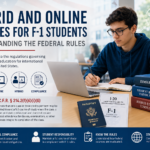


SEVP warns universities and DSOs about improper Curricular Practical Training authorizations and announces increased scrutiny. The new guidance does not eliminate CPT or expressly ban so-called Day 1 CPT, but it signals a stricter interpretation of when practical training may qualify as an integral part of the curriculum.
The U.S. government has increased its scrutiny of Curricular Practical Training (CPT), a form of practical training that allows certain F-1 international students to engage in employment or training as part of their academic program.
On August 12, 2026, the Student and Exchange Visitor Program (SEVP), a component of U.S. Immigration and Customs Enforcement (ICE), issued Broadcast Message 2608-01 — “Reminder of Liability for DSOs Regarding CPT Authorization.”
The message was directed to Designated School Officials (DSOs) and Principal Designated School Officials (PDSOs) at SEVP-certified institutions.
According to SEVP, the agency has observed an increase in CPT authorizations that appear not to satisfy federal regulatory requirements, particularly where the practical training does not genuinely constitute an integral part of an established academic curriculum.
As a result, SEVP announced increased scrutiny of CPT authorizations.
The development is especially relevant to universities offering programs commonly referred to as “Day 1 CPT,” in which certain graduate students may be authorized for practical training at or near the beginning of their academic program.
However, the new guidance must be read carefully.
The U.S. Government Did Not Eliminate CPT
Broadcast Message 2608-01 does not eliminate CPT.
It also does not directly amend the language of 8 C.F.R. § 214.2(f)(10)(i), the federal regulation governing Curricular Practical Training for F-1 students.
That regulation continues to state that an F-1 student may participate in CPT when the training is an:
“integral part of an established curriculum.”
The regulation recognizes forms of curricular practical training such as alternative work/study, internships, cooperative education, and required internships or practica offered through cooperation between a school and an employer.
The Graduate-Level Exception for Immediate Practical Training Still Exists
As a general rule, F-1 students must complete one academic year before becoming eligible for practical training.
However, the regulation contains an important exception for graduate students enrolled in programs that require immediate participation in Curricular Practical Training.
That exception remains in 8 C.F.R. § 214.2(f)(10)(i).
This provision is one of the principal regulatory foundations for what is informally known as Day 1 CPT.
ICE guidance also continues to recognize that a graduate student may be authorized for CPT immediately when the academic program requires practical training from the outset.
For that reason, it would be legally inaccurate to say that the government has simply “banned Day 1 CPT.”
So What Actually Changed?
What clearly changed is the government’s enforcement posture.
SEVP states that it has identified CPT authorizations that appear not to comply with existing legal requirements and that it intends to increase scrutiny of schools, DSOs, and academic programs.
The message emphasizes that CPT cannot function merely as a mechanism to allow an international student to work in the United States.
The practical training must be genuinely connected to the academic program.
Relevant factors include:
- a direct relationship between the training and the student’s major;
- genuine integration with the curriculum;
- appropriate academic documentation;
- authorization by the DSO before employment begins;
- a legitimate curricular basis for the practical experience.
Most of those requirements are not new.
The most significant development is how SEVP is now describing and enforcing the concept of “integral.”
The Most Important Part of the New Guidance
Broadcast Message 2608-01 states that SEVP may request documentation and other evidence to determine whether a CPT opportunity is truly central to a student’s academic studies, including whether the experience is one without which the student would be unable to complete the degree.
The guidance also instructs DSOs to consider whether the employment associated with CPT is required for all students pursuing that degree.
That wording is important.
The regulation itself uses the phrase:
“integral part of an established curriculum.”
The new SEVP guidance, however, emphasizes concepts such as whether the training is necessary for degree completion and whether it is required for all students in the program.
That distinction may have significant practical consequences.
Does “Integral” Necessarily Mean “Mandatory for Every Student”?
This is one of the most important legal questions raised by the new guidance.
The regulation does not literally say:
“mandatory for every student.”
It says that the training must be an integral part of an established curriculum.
Historically, universities have structured CPT in different ways, including:
- required internships;
- practica;
- cooperative education;
- academic courses connected to internships;
- practical training linked to academic credit;
- experiential learning incorporated into the curriculum.
There is therefore a meaningful distinction between saying that a practical experience must be genuinely integrated into the curriculum and saying that the exact training must be mandatory for every student enrolled in the degree program.
That distinction could become legally significant if SEVP begins using its new interpretation to challenge curricular models that schools previously considered compliant.
The Likely Focus of Enforcement
The logic behind the new guidance is relatively clear.
SEVP appears to be distinguishing between two very different situations.
In the first, an academic program genuinely requires practical experience because of the nature of the degree.
The student must complete an internship, practicum, cooperative education experience, or other form of training because it is truly part of the academic program.
In the second, a student first has a desire or need to work, and an academic structure is then created primarily to characterize that employment as CPT.
The second scenario presents substantially greater risk.
In simple terms:
The training should exist because the curriculum requires the experience. The curriculum should not be designed merely because the student wants employment authorization.
Is Day 1 CPT Still Allowed?
The most accurate answer requires nuance.
Day 1 CPT has not been expressly banned.
The regulation still contains the graduate-level exception for programs that require immediate participation in practical training.
However, programs relying on that exception are likely to face increased scrutiny.
The central question will be:
Does the academic program genuinely require practical training from the beginning, or does the structure primarily exist to provide employment authorization to the student?
That distinction may become decisive.
Increased Responsibility for DSOs
Another major feature of Broadcast Message 2608-01 is its focus on the responsibility of Designated School Officials.
The DSO is responsible for authorizing CPT in SEVIS and issuing or updating the student’s Form I-20.
By authorizing CPT, the DSO is effectively certifying that the training satisfies the applicable requirements.
The new guidance reinforces that improper authorizations may create consequences not only for the student, but also for the DSO and the institution.
SEVP may request documentation, review institutional practices, and investigate schools that it believes are using CPT in a manner inconsistent with federal regulations.
The Risk Is Also Institutional
The new scrutiny is not limited to individual students.
SEVP may examine how an institution has structured its academic programs and CPT policies.
That may include review of:
- curriculum requirements;
- university catalogs;
- program descriptions;
- course requirements;
- internship policies;
- cooperative agreements;
- records maintained by DSOs;
- the relationship between practical training and academic requirements.
Schools that use CPT systematically in a manner SEVP considers inconsistent with federal regulations may face consequences related to their SEVP certification.
What Happens to Students Who Already Have CPT?
Broadcast Message 2608-01 does not state that previously authorized CPT has been automatically canceled.
It also does not say that CPT authorizations became invalid on August 12, 2026.
However, the increased scrutiny makes documentation more important than ever.
A student who has used CPT should be able to demonstrate a clear relationship between:
degree → curriculum → course or practicum → practical training → employer → job duties.
The clearer that chain is, the stronger the student’s documentary position.
Documents Students Should Preserve
In light of SEVP’s new enforcement posture, students who currently use or previously used CPT should preserve documentation related to their authorization, including, when available:
- all Forms I-20;
- CPT authorizations;
- employment offer letters;
- cooperative agreements;
- official degree descriptions;
- university catalogs;
- curriculum materials in effect during the relevant period;
- course syllabi;
- proof of academic credit;
- transcripts;
- enrollment records;
- internship evaluations;
- documents showing the relationship between the employment and the student’s major;
- university CPT policies in effect during the relevant period.
These materials may become important in future immigration proceedings where the government reviews maintenance of F-1 status or prior employment authorization.
CPT on the I-20 May No Longer Be the End of the Analysis
Many students have traditionally focused on whether their Form I-20 contains a valid CPT authorization.
Under the new enforcement environment, that formal authorization may no longer be the only issue the government examines.
The government may also ask:
Why was the CPT authorized?
In other words, beyond the existence of the authorization itself, the student may need to demonstrate the legitimate academic basis supporting that decision.
This may be particularly important in future immigration processes involving:
- H-1B;
- change of status;
- adjustment of status;
- other immigration benefits requiring review of prior status history.
This does not mean that students with Day 1 CPT will automatically encounter problems.
It means that their history may receive closer scrutiny.
The Guidance Is Not Limited to Day 1 CPT
Another important point is that Broadcast Message 2608-01 concerns CPT generally.
The government’s concern is not limited to the first semester.
A student may complete one academic year and still have a problematic CPT authorization if the practical training is not genuinely integral to an established curriculum.
Conversely, a graduate student may begin CPT immediately and still comply with the regulation if the program genuinely requires practical training from the outset.
Therefore:
CPT after one academic year is not automatically valid.
And:
CPT during the first semester is not automatically invalid.
The analysis depends on the actual academic structure of the program.
What the Guidance Allows Us to Say — and What Would Be an Overstatement
Based on the official SEVP guidance, it is accurate to say:
The U.S. government has increased scrutiny of CPT.
SEVP is concerned about CPT authorizations that are not genuinely integral to the curriculum.
DSOs and institutions may face consequences for improper CPT authorizations.
Programs allowing immediate practical training are likely to receive greater scrutiny.
The academic legitimacy of CPT will become increasingly important.
It would be an overstatement, based solely on Broadcast Message 2608-01, to claim:
“CPT has ended.”
“Day 1 CPT has been banned.”
“Every student using Day 1 CPT is out of status.”
“All previously authorized CPT is now invalid.”
None of those conclusions is expressly stated in the SEVP Broadcast Message.
The Most Important Legal Question
The most significant issue may ultimately be SEVP’s interpretation of the regulatory phrase:
“integral part of an established curriculum.”
If the government begins requiring practical training to be both indispensable to degree completion and mandatory for every student in the program, a legal question may arise over the difference between:
enforcing an existing regulation
and
creating a more restrictive substantive condition through agency guidance.
That issue could become particularly important if the new interpretation is later used to impose consequences on schools, DSOs, or students.
Conclusion
Broadcast Message 2608-01 represents an important shift in the enforcement environment surrounding Curricular Practical Training.
It does not, by itself, end CPT or formally prohibit Day 1 CPT.
Federal regulations continue to authorize CPT as an integral part of an established curriculum and continue to preserve the exception for graduate programs requiring immediate participation in practical training.
What has clearly changed is the level of scrutiny and the way SEVP is emphasizing the meaning of an experience being truly “integral” to the curriculum.
For universities, the new guidance increases the importance of compliance and documentation.
For DSOs, it increases the responsibility associated with each CPT authorization.
And for students, particularly those enrolled in programs that authorize CPT from the beginning, it becomes even more important to preserve evidence showing that the practical experience was genuinely connected to a legitimate academic structure.
The central question is no longer only:
“Is CPT listed on the Form I-20?”
It is increasingly also:
“Why was this CPT authorized, and how was it genuinely part of the academic program?”
Official Sources
ICE / SEVP — Broadcast Message 2608-01: “Reminder of Liability for DSOs Regarding CPT Authorization” (August 12, 2026)
https://www.ice.gov/doclib/sevis/pdf/bcm260801.pdf
eCFR — 8 C.F.R. § 214.2: Federal regulation governing F-1 status and Curricular Practical Training (CPT)
https://www.ecfr.gov/current/title-8/chapter-I/subchapter-B/part-214/section-214.2
ICE / SEVP — Practical Training: Official guidance for F-1 students on CPT and OPT
https://www.ice.gov/sevis/practical-training
ICE / SEVP — Curricular Practical Training (CPT): Official SEVP guidance document
https://www.ice.gov/doclib/sevis/pdf/CurricularPracticalTraining.pdf
USCIS Policy Manual — Volume 2, Part F, Chapter 5: Practical Training for F-1 students
https://www.uscis.gov/policy-manual/volume-2-part-f-chapter-5
ICE / SEVP — Practical Training Overview: Official overview of CPT, OPT and STEM OPT
https://www.ice.gov/doclib/sevis/pdf/SEVPPracticalTrainingOverview.pdf